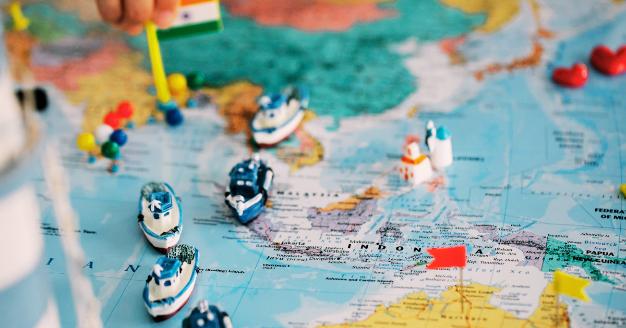

Forget armies and bombs. These six countries control the world’s most important bottlenecks—narrow straits, canals, and passages that billions of dollars flow through every single day. And they didn’t even need to fight for it.
Six Countries That Quietly Control the World’s Most Important Chokepoints
You know what’s wild?
The entire global economy—trillions of dollars of goods, oil, and resources—flows through a handful of narrow passages. Not highways. Not borders. Just… tiny strips of water and land that you probably wouldn’t notice on a map.
But if one of them gets blocked? The whole world feels it.
These are called chokepoints. And the countries that control them? They’ve got more leverage than most superpowers could dream of. No nukes required.
Here are six countries whose geography gives them quiet, ridiculous influence over how the world moves.
1. Egypt – The Owner of the World’s Most Famous Shortcut
The Suez Canal is basically the cheat code of global shipping.
Instead of sailing all the way around Africa—which takes forever and burns a fortune in fuel—ships can just cut through Egypt. Mediterranean to Red Sea. Europe to Asia. Boom.
And when that massive container ship Ever Given got stuck in 2021? Global trade ground to a halt. Hundreds of ships backed up. Billions of dollars in delays. All because one vessel got wedged in a 193-kilometre ditch.
That’s the power Egypt holds. Not military might. Just… a really well-placed canal.
The takeaway: Sometimes, the shortest path between two points is worth more than gold.
2. Turkey – The Doorkeeper of the Black Sea
Turkey doesn’t just sit between Europe and Asia. It sits on the doorway between the Black Sea and the Mediterranean.
The Bosporus and Dardanelles straits—collectively the Turkish Straits—are the only way in or out of the Black Sea for major naval and commercial vessels.
That means Russia, Ukraine, Georgia, and a bunch of other countries all have to ask Turkey’s permission—or at least play nice—whenever they want to move ships through.
It’s not about owning the whole sea. It’s about owning the front door.
The takeaway: You don’t need to control the whole neighbourhood. Just the gate.
3. Panama – The Connector of Two Oceans
Panama is tiny. Like, really tiny. But what it lacks in size, it makes up for in location.
The Panama Canal links the Atlantic and Pacific Oceans, saving ships from the nightmare of sailing all the way around South America. That’s thousands of kilometres and weeks of travel time saved.
For global shipping, that shortcut is pure gold.
And for Panama? It’s a geopolitical jackpot. The country may not have a massive army or a huge population, but it sits right where two oceans almost touch. And that’s enough.
The takeaway: In geopolitics, being in the right place beats being the biggest place. Every time.
4. Singapore – The Tiny Giant Beside a Maritime Highway
Singapore is an island city-state. Small enough that you could drive across it in under an hour.
But it sits right next to the Strait of Malacca—one of the busiest shipping corridors on the planet.
We’re talking enormous volumes of oil, manufactured goods, and raw materials flowing between the Indian Ocean and the Pacific. And Singapore? It parked itself right beside the action.
The country turned that location into a logistics and financial powerhouse. One of the world’s busiest ports. A hub for shipping, banking, and trade.
It doesn’t own the strait. But it’s right there. And that’s more than enough.
The takeaway: You don’t always need to own the whole chokepoint. Sometimes, being its neighbour is just as good.
5. Iran – Sitting Next to the World’s Energy Pressure Point
If the global energy system had a pressure valve, it would be the Strait of Hormuz.
This narrow passage connects the Persian Gulf to the open ocean. And through it flows a massive chunk of the world’s oil and natural gas.
Iran sits on one side. Oman on the other.
Now imagine if that strait got blocked—even for a few days. Oil prices would spike. Inflation would spread. Industries would slow down. Economies would feel the pain.
That’s the leverage Iran has. Not because it produces all the oil. But because it sits beside the gateway through which so much of it travels.
The takeaway: You don’t need to control the whole energy market. Just the doorway to it.
6. Russia – The Arctic’s Emerging Power Player
Russia’s chokepoint game is a little different from the others.
Instead of a centuries-old canal or strait, Russia is banking on the Northern Sea Route—a shipping lane along its Arctic coastline that’s becoming more accessible as ice melts.
It’s not a major trade route yet. But it could be. And if it is, Russia will have a huge head start—with ports, icebreakers, military infrastructure, and the longest Arctic coastline in the world.
The Arctic isn’t the Suez Canal. Not yet. But in a few decades? It could be a game-changer.
The takeaway: Sometimes the most powerful chokepoints aren’t the ones that exist today. They’re the ones that are just beginning to open up.
What Makes These Places So Powerful?
Here’s the thing that blows my mind.
None of these countries got their power by conquering anyone. They just… happened to be born in the right spot.
Egypt has the Suez. Turkey has the Straits. Panama has the Canal. Singapore sits beside Malacca. Iran borders Hormuz. Russia has the Arctic coastline.
And because of that, they have influence that far outweighs their size or military budget.
It’s a weird truth about globalization: the world looks huge and connected, but so much of it funnels through a handful of narrow bottlenecks.
And when billions of dollars depend on those bottlenecks, geography becomes power.
So… What’s the Real Lesson Here?
Next time you look at a world map, don’t just stare at the big countries.
Look at the gaps between them.
The straits. The canals. The mountain passes. The narrow waterways.
Because sometimes, the most important piece of real estate on Earth isn’t a capital city or an oil field. It’s a 30-kilometre stretch of water that everyone needs to cross.
In geopolitics, the question isn’t always “Who owns the most?”
Sometimes, it’s “Who controls the way through?”
SixGlobe Takeaway
Chokepoints rarely make headlines when everything’s running smoothly. But when they get blocked—whether by a stuck ship, a political spat, or melting ice—the whole world suddenly remembers they exist.
That’s why these six countries matter. Not because they’re the biggest or the strongest. But because they sit right where the world needs to pass.
And in a globalised economy, that’s a superpower all its own.
Enjoyed this? There’s a whole world of hidden geopolitics waiting for you. Head over to SixGlobe for more deep dives into the places that quietly shape our world—and the ones that might just blow up next.


