Six Places Where It Can Literally Rain Fire, Metal, or Acid
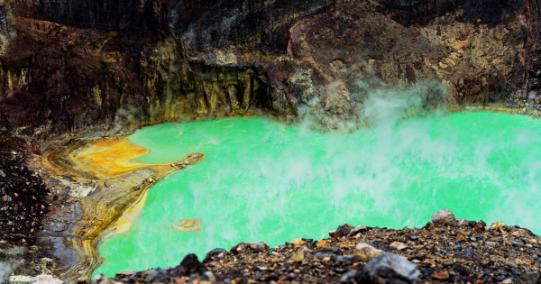
From sulfuric acid on Venus to iron on WASP-76b, discover six places where rain can be far stranger than anything on Earth.
Six Places Where It Can Literally Rain Fire, Metal, or Acid
We tend to think of rain as one of the simplest things in nature: clouds form, water droplets grow, and eventually they fall.
But that description only works if you’re talking about Earth.
Across the Solar System—and even on planets orbiting distant stars—”rain” can mean something completely different. On one world, droplets of sulfuric acid fall through the atmosphere. On another, scientists have found evidence that iron vapor may condense and fall on the permanent night side. Somewhere else, carbon may be squeezed into diamond crystals deep inside a planet.
The strangest part is that these aren’t science-fiction weather systems. They are consequences of real chemistry, temperature and pressure.
Here are six places where precipitation gets seriously weird.
1. Venus — Rain Made of Sulfuric Acid
Venus looks bright and peaceful from Earth. Up close, it’s anything but.
The planet is wrapped in thick clouds containing sulfuric acid, while its atmosphere is dominated by carbon dioxide. The surface is hot enough to melt lead, with atmospheric pressure roughly 93 times that at Earth’s sea level.
Higher in the atmosphere, sulfuric acid can condense into droplets and fall as acid rain.
But there’s a strange catch: the rain doesn’t make it to the ground.
As the droplets descend into the much hotter lower atmosphere, they evaporate before reaching the surface, sending the material back upward in a bizarre atmospheric cycle. NASA describes Venus as having clouds of sulfuric acid and an extreme environment where this rain evaporates before reaching the surface.
Recent reanalysis of old Pioneer Venus data has also suggested that Venusian cloud aerosols may contain substantial water alongside sulfuric acid and iron sulfate, making the chemistry of those clouds even more complicated than scientists once thought.
So technically, Venus has acid rain.
It just never reaches the ground.
2. WASP-76b — Where Iron Can Fall From the Sky
This may be the most metal weather forecast in astronomy.
WASP-76b is an ultra-hot gas giant roughly 640 light-years away. Its dayside reaches temperatures above 2,400°C, hot enough to vaporize metals such as iron.
The planet is tidally locked, meaning one side constantly faces its star while the other remains in permanent darkness.
That creates an extraordinary atmospheric system.
Iron can exist as vapor on the scorching dayside. Powerful winds then carry that iron vapor toward the cooler nightside. As it cools, the iron can condense into droplets.
And those droplets may fall as iron rain.
Astronomers detected signatures consistent with this process using the European Southern Observatory’s Very Large Telescope.
There is still active research into exactly how the atmosphere behaves, so “it rains iron” should be understood as the leading interpretation of observations rather than watching literal raindrops through a window.
Still, somewhere 640 light-years away, weather may involve metal falling from the sky.
3. Saturn and Jupiter — Where Carbon Could Become Diamond Rain
Now things get even stranger.
Deep inside giant planets such as Saturn and Jupiter, pressures become enormous. Under the right conditions, carbon-containing compounds can be broken apart, allowing carbon to form solid structures.
One proposed result is diamond precipitation deep inside these planets.
The idea isn’t that enormous gemstones are falling through an open sky. These planets don’t have a solid surface like Earth, and the “rain” occurs deep within their dense atmospheres under extraordinary pressure and temperature.
As carbon descends, increasing pressure could transform it into diamond-like crystalline material before it eventually encounters even more extreme conditions deeper inside the planet.
Scientists continue to investigate the exact chemistry and physical conditions involved, so diamond rain remains a model-dependent phenomenon rather than something directly observed.
But the physics behind the possibility is fascinating: on a gas giant, carbon that begins as part of an atmospheric molecule could potentially end up as a solid crystal falling deeper into the planet.
Imagine calling that a weather forecast.
4. Titan — Methane Takes the Place of Water
Saturn’s largest moon, Titan, is one of the closest things in our Solar System to an alien version of Earth.
It has clouds, rivers, lakes and rainfall.
But there is one enormous difference.
The liquid isn’t water.
Titan is so cold that methane and ethane can exist as liquids on its surface. Methane evaporates into the atmosphere, forms clouds and can then fall back to the surface as methane rain.
In other words, Titan has something resembling Earth’s water cycle—but with hydrocarbons replacing water.
Methane can evaporate, condense, fall as rain and flow across the landscape.
There are even lakes and seas of liquid hydrocarbons.
It’s one of the clearest examples of how the basic idea of a “weather cycle” doesn’t require water at all. Change the temperature and chemistry of a world, and the entire meaning of rain can change with it.
5. Neptune — A World Where Pressure May Forge Diamonds
Neptune doesn’t have a surface you could stand on. Beneath its atmosphere lies a deep, dense interior where pressure and temperature rise dramatically.
Scientists have long considered the possibility that carbon compounds inside ice giants such as Neptune and Uranus could break apart under these extreme conditions.
The carbon could then crystallize into diamond.
Laboratory experiments have strengthened the idea. Researchers have recreated some of the extreme conditions expected inside ice giants and produced tiny diamond-like structures from carbon-rich materials.
If the process happens naturally inside Neptune, those crystals would be considerably denser than the surrounding material and could sink downward.
That creates what scientists describe as diamond rain.
And there’s an interesting consequence: as those dense carbon crystals sink, their movement could potentially contribute to the internal heat budget and dynamics of these planets.
So the diamonds aren’t just a bizarre curiosity.
They may actually be part of how an alien planet works from the inside.
6. Earth — When the Sky Really Does Rain Fire
You don’t have to leave Earth to find something that looks like weather from another planet.
During extreme wildfires, intense heat can create powerful upward-moving columns of air. Under the right conditions, rotating winds can organize these columns into fire whirls or much larger fire tornado-like vortices.
These aren’t ordinary tornadoes with flames simply attached to them.
The fire itself can generate powerful convection, while rotating air can pull flames, ash and burning debris upward.
The result can look as though the atmosphere itself is raining or throwing fire.
Strictly speaking, this isn’t “fire rain” in the astronomical sense. Fire doesn’t condense from a cloud and fall like water. But it demonstrates something important: extreme weather can completely blur the line between atmosphere, chemistry and combustion.
And unlike iron rain on a distant exoplanet, this phenomenon can happen close enough to be genuinely dangerous.
The Strange Lesson Behind All This
Rain isn’t really about water.
At its most basic level, precipitation happens when material in an atmosphere changes phase, becomes sufficiently dense, and falls under gravity.
On Earth, that material is usually water.
On Titan, it can be methane.
On Venus, sulfuric acid droplets can form high in the atmosphere.
On WASP-76b, extreme heat may turn iron into vapor before cooler regions allow it to condense.
And deep inside giant planets, extraordinary pressure may transform carbon into crystalline material.
The rules of physics haven’t changed.
The ingredients have.
That may be the most fascinating thing about alien weather. Nature doesn’t need to invent new laws to create impossible-looking worlds. It simply takes familiar physics and pushes it into environments that Earth never experiences.
And somewhere in the universe, there could be a planet where the forecast is stranger still.












Post Comment