Madagascar: The World’s Strangest Island – Six Incredible Reasons Why
Discover why Madagascar is unlike any other place on Earth. From bizarre wildlife and giant baobab trees to razor-sharp stone forests, explore six fascinating reasons this island is one of nature’s greatest wonders.
Madagascar: The World’s Strangest Island
Far off the southeastern coast of Africa lies an island unlike any other place on Earth. Stretching over 587,000 square kilometers, Madagascar is the world’s fourth-largest island, yet it feels more like a separate continent than an ordinary island. Scientists often describe it as a “living laboratory of evolution” because of the extraordinary plants and animals that have developed there over millions of years.
Separated from mainland Africa for around 88 million years, Madagascar has evolved into one of the most extraordinary places on Earth. Often called the world’s eighth continent, the island is home to landscapes, plants, and animals that exist nowhere else. Nearly 90% of its wildlife is endemic, meaning it cannot naturally be found anywhere else on the planet. Millions of years of isolation have allowed nature to experiment in remarkable ways, creating an island filled with strange creatures, dramatic scenery, and unique cultures.
Here are six reasons why Madagascar truly deserves the title of the world’s strangest island.
1. Wildlife Found Nowhere Else on Earth
Madagascar is best known for its incredible biodiversity. More than 100 species of lemurs live on the island, from the tiny mouse lemur, one of the world’s smallest primates, to the large Indri, whose haunting calls echo through the forests. Alongside lemurs are colorful chameleons, unusual frogs, leaf-tailed geckos, and the mysterious aye-aye, an animal so strange that it was once believed to be a bad omen.
Scientists estimate that nearly 90% of Madagascar’s plants and animals evolved independently after the island split from other landmasses millions of years ago. This extraordinary isolation turned Madagascar into a living laboratory of evolution.
2. The Island of Giant Baobab Trees
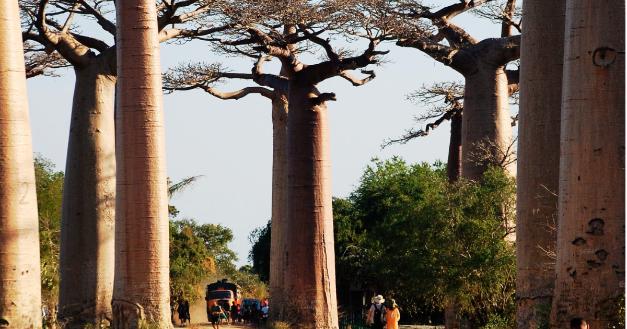
One of Madagascar’s most iconic sights is the Avenue of the Baobabs. These massive trees can live for over a thousand years and store enormous amounts of water in their thick trunks to survive long dry seasons.
Six of the world’s eight baobab species are native to Madagascar. Their upside-down appearance has inspired countless legends, making them one of the island’s most recognizable natural landmarks. During sunrise and sunset, these ancient giants create one of Africa’s most breathtaking landscapes.
3. Razor-Sharp Stone Forests
Madagascar is home to one of Earth’s most unusual geological formations: the Tsingy. These limestone formations rise hundreds of feet into the air as razor-sharp stone pinnacles that resemble a forest made of rock.
Over millions of years, rainwater dissolved the limestone into narrow canyons, caves, and towering spikes. Many areas are so difficult to access that unique plants and animals evolved there in complete isolation. Today, the Tsingy is recognized as one of the planet’s most spectacular natural wonders.
4. A Landscape That Changes Dramatically
Few islands offer as much geographic diversity as Madagascar. Dense rainforests dominate the eastern coast, while the south is covered by dry deserts filled with strange spiny forests. The central highlands feature rolling hills, rice terraces, and ancient villages, while the western coastline boasts mangroves, beaches, and coral reefs.
This remarkable variety of ecosystems explains why Madagascar supports such an incredible range of wildlife and plant species despite being a single island.
5. A Culture Unlike Anywhere Else
Madagascar’s people have a fascinating heritage. Unlike most African nations, the Malagasy people have both African and Southeast Asian ancestry. Historians believe early settlers crossed thousands of kilometers across the Indian Ocean from present-day Indonesia before mixing with African populations over centuries.
This unique history shaped Madagascar’s language, traditions, architecture, music, and cuisine. Ancient customs such as the Famadihana, or “turning of the bones” ceremony, continue to be practiced in some regions, reflecting the deep connection between families and their ancestors.
6. An Island Still Full of Mysteries
Even today, Madagascar continues to surprise scientists. New species are discovered almost every year, including frogs, reptiles, insects, and plants previously unknown to science.
Hidden caves preserve fossils of giant extinct lemurs, while remote forests remain largely unexplored. Offshore, nearby volcanic islands continue to remind researchers that the region remains geologically active. Madagascar remains one of the last great frontiers for biological discovery.
Why Madagascar Matters
Madagascar is more than a beautiful destination. It is one of the world’s most important biodiversity hotspots. Unfortunately, deforestation, habitat loss, and climate change threaten many of its unique species. Conservation efforts aim to protect these ecosystems before they disappear forever.
Studying Madagascar also helps scientists better understand evolution, adaptation, and how isolated ecosystems develop over millions of years.
Conclusion
Madagascar is unlike anywhere else on Earth. Its incredible wildlife, ancient baobab trees, razor-sharp stone forests, diverse landscapes, rich cultural heritage, and ongoing scientific discoveries make it one of the planet’s most fascinating destinations. Millions of years of isolation transformed this island into a natural wonder that continues to amaze researchers and travelers alike.
Whether you’re passionate about wildlife, geology, history, or adventure, Madagascar offers experiences that simply cannot be found anywhere else.
Follow SixGlobe for more fascinating articles exploring the world’s most incredible places, scientific discoveries, history, technology, and natural wonders.
Thank you 🙂












Post Comment