Six Things the USA and China Are Quietly Competing to Control — Who Will Win the Future?
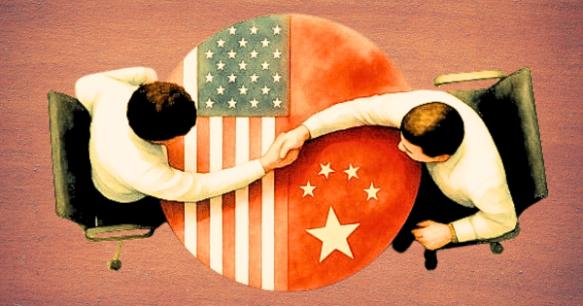
USA vs China competition is moving beyond trade. Discover six critical areas—from AI and chips to rare earths and space—that could determine who shapes the future.
Six Things the USA and China Are Quietly Competing to Control — Who Will Win the Future?
The rivalry between the United States and China is no longer just about tariffs, military power, or trade. Increasingly, it is about something much bigger: who controls the technologies, resources, and infrastructure that will shape the next few decades.
From artificial intelligence and semiconductors to rare-earth minerals and electric vehicles, both countries are trying to reduce their dependence on the other while expanding their own influence. China dominates important parts of several critical supply chains, while the U.S. retains major advantages in advanced technology, capital, research, and global alliances.
But what exactly are they competing to control—and which side has the stronger position?
1. Artificial Intelligence
AI may become one of the most important strategic technologies of the 21st century.
The U.S. currently has major strengths in frontier AI companies, advanced computing, semiconductor design, and access to enormous amounts of private capital. China, however, is pursuing a more integrated approach, developing everything from chips and computing infrastructure to AI models and industrial applications.
The competition is therefore not simply about creating the smartest chatbot.
AI could transform military systems, manufacturing, transportation, medicine, finance, cybersecurity, and scientific research. Whoever develops the strongest AI ecosystem could gain an enormous economic and strategic advantage.
And there is an interesting twist: restrictions designed to slow China’s access to advanced technology may also be encouraging Chinese companies and researchers to build more self-reliant and open AI ecosystems.
The real question: Will America’s lead in frontier AI remain, or will China’s scale eventually close the gap?
2. Semiconductors
Tiny computer chips sit at the center of the modern economy.
Smartphones, AI servers, cars, satellites, weapons, robots, and countless everyday devices depend on increasingly sophisticated semiconductors.
The U.S. has enormous influence over semiconductor design, intellectual property, equipment, and advanced computing technology. China, meanwhile, is investing heavily in domestic semiconductor capabilities because dependence on foreign technology has become a strategic vulnerability.
This has turned chips into something far more important than a commercial product. They have become geopolitical leverage.
Washington has used export controls to restrict China’s access to some advanced semiconductor technologies, while Beijing has responded by strengthening domestic capabilities and restricting access to certain critical materials.
The result is a technological race in which both sides are trying to make themselves harder to pressure.
3. Rare-Earth Minerals
This may be one of the most surprising battlegrounds.
Rare-earth elements are essential for permanent magnets used in electric vehicles, wind turbines, electronics, industrial machinery, and military systems. China produces roughly 60% of the world’s rare earths and processes almost 90% of rare-earth magnets, giving it enormous influence over the supply chain.
That creates a strange imbalance.
America may lead in many advanced technologies, but some of those technologies still depend on materials that China has a much stronger position in producing and processing.
The U.S. is now trying to build alternative supply chains and increase domestic processing. Recent efforts include government support for American producers and new processing and magnet facilities.
This is why rare earths are becoming a strategic weapon without looking like one.
Control the material, and you may influence who can build the technology.
4. Electric Vehicles and Batteries
China has built an enormous manufacturing ecosystem around electric vehicles, batteries, solar technology, and related components.
Its advantage isn’t simply producing individual cars. It comes from the broader industrial network behind them—from batteries and components to manufacturing capacity and supply chains.
The U.S. is attempting to build a stronger domestic EV and battery ecosystem while also protecting its market from Chinese competition.
This matters because the automobile industry is undergoing a fundamental transformation.
The car of the future could be less about engines and more about software, batteries, autonomous systems, sensors, and AI.
If China becomes the world’s dominant producer of these technologies, it could gain enormous industrial influence. If America successfully rebuilds its manufacturing ecosystem, the balance could shift again.
5. Space Technology
The next great competition may not stay on Earth.
The United States has decades of experience and a powerful private space industry. Companies such as SpaceX have dramatically changed the economics of launching spacecraft and building satellite networks.
China, meanwhile, has developed an increasingly ambitious space program, including lunar exploration, space stations, satellites, and plans for deeper exploration.
The competition matters because space infrastructure is becoming increasingly connected to communications, navigation, Earth observation, scientific research, and national security.
The country that develops the strongest space ecosystem could eventually control important pieces of the infrastructure that connects the planet.
And unlike a traditional military race, this competition could also be driven by commercial companies rather than governments alone.
6. The Global Supply Chain
Perhaps the biggest competition of all is over something most people never see: where the world’s products are made.
For decades, China became the world’s manufacturing powerhouse, developing enormous industrial clusters and supply chains.
The U.S. remains a financial, technological, and innovation powerhouse, but it has become increasingly concerned about depending on China for critical products and materials.
That is why Washington is encouraging companies to diversify manufacturing and build more strategic production at home or in friendly countries.
China, meanwhile, continues to possess enormous manufacturing scale and influence over critical supply chains.
The objective on both sides is increasingly similar:
Don’t let your biggest rival become indispensable to your economy.
So, Who Will Win?
The answer may not be as simple as USA vs. China.
America has major advantages in frontier technology, advanced semiconductor design, private capital, entrepreneurship, research institutions, and alliances.
China has extraordinary manufacturing scale, infrastructure-building capacity, supply-chain depth, and growing strength in areas such as EVs, batteries, industrial automation, and critical minerals.
And the competition is happening simultaneously across multiple industries.
The U.S. doesn’t need to dominate everything to remain the world’s most influential technological power. China doesn’t need to surpass America everywhere either.
The more likely future could be a fragmented technological world, where the two powers lead different parts of the global economy while other countries attempt to avoid becoming completely dependent on either side.
The biggest question isn’t simply who will beat whom.
It is who will control the technologies and resources that everyone else needs.
Conclusion
The USA-China rivalry is evolving from a traditional competition between two powerful countries into a struggle over the foundations of the future economy.
AI could determine who thinks faster. Semiconductors could determine who computes faster. Rare earths could determine who can manufacture critical technologies. Batteries and EVs could determine industrial leadership. Space could determine the next strategic frontier. And supply chains could determine who remains economically independent.
The winner may ultimately be the country that can connect all six together.
Because in the next era of global competition, controlling the future may be more important than controlling the present.














Post Comment